


AIR VELOCITY DETECTOR
MODEL SAF11
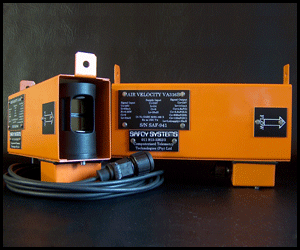
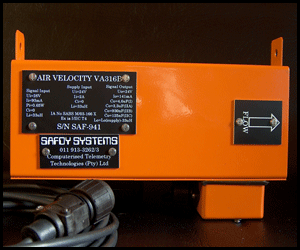
The Safdy range of Air Velocity detectors are used in the mining environment to continuously monitor the "airflow rate" of the mine ventilation. The Safdy Velocity Detector connects to a Telemetry System and displays the information on software Scada package.


DESCRIPTION
· ·Remote sensing head for continuously monitoring airflow.
· Designed to be interfaced to a remote Telemetry System.
· The output of the Airflow sensor can be displayed as trend graphs on a Scada software
program.
· Originally designed for the South African mining industry, specifically to monitor
underground in
the gold, coal or diamond mine, but can also be used for Industrial
applications.
· Airflow speed maximum range of 40m/s or 144 km/hour.
· Linear output proportional to airspeed.
· Highly accurate, dependant on the width of the "accentuater" bar.
· Calibration is a function of the width of the bar.
· Rapid response of change of airflow.
· Excellent repeatability inherent to the vortex principles.
· Very low lifecycle costs due to no moving parts.
· Insensitive to small particles, dust or water droplets in the air stream.
· Internal DIL switch for different ranges of airspeed.
· Output is a standard 4mA to 20mA.
· Or can be used on the Anglo System to give a 0mA to 1mA output.
TEST CERTIFICATES AND APPROVALS
· Approved as intrinsically safe for use in coalmines.
· SABS approved for explosion prove.
· CSIR report on suitability.
CONSTRUCTION
· Solid-state design airflow sensor.
· Measures airflow using the VORTEX method.
· Vortex method is a proven way to measure the airflow very accurately.
· Vortex method is independent of small particles present in the air stream – like water
triplets.
· The airflow sensor is housed in a stainless steel box
· The lifespan of the airflow detector can be in excess of ten years.
METHOD OF OPERATION
The solid-state airflow sensor was developed for monitoring airflow to ensure that the mine
ventilation system is in order.
In underground mining activity the air is mixed with all sorts of contamination – to an extent
that
it is becoming toxic for human life. This air has to be mixed with enough fresh air in
order to keep
contamination to an acceptable level. Air circulation in the underground mines
is achieved by using
various extractor and / or intake fans.
When an extractor and / or intake fan fails, the airflow will decrease, and the airflow sensor
will give
a corresponding smaller signal output – so that the ventilation officer can be alerted.
The vortex
method is the proven way to measure the airflow very accurate and independent
on small particles.
TECHNICAL DATA
| Supply voltage | 7 to 24V DC |
| Power consumption | 5mA + loop current (4-20mA) |
| Range normal | 0,4m/s to 15m/s DIL switch selectable |
| Other ranges | Any range up to 40m/s |
| Output | 4mA to 20mA (standard) 0mA to 1mA (alternate) |
| Housing | Stainless steel powder coated orange |
| Explosion protection | SABS M/03 – 166X Ex ia Group I T4 |
| Approval Rating | Supply Input 24V and 2Amp |
| Dimension | 250 x 140 x 75mm |
| Weight | 1,6kg |
VORTEX SHEDDING METERS
PRINCIPLE OF OPERATION
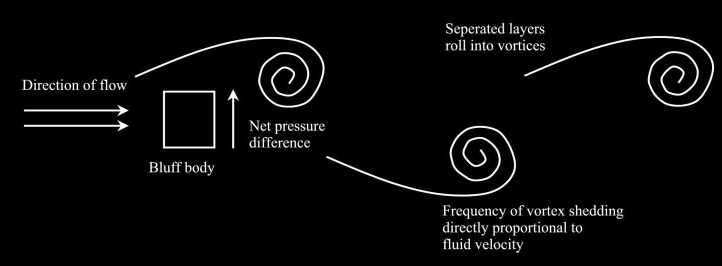
The operating principle of the vortex meter is based upon a natural phenomenon known as vortex shedding. When a fluid passes over an obstacle, boundary layers of slow moving fluid are formed along the outer surface. If the obstacle is not streamlined (i.e. if it is a bluff body) the flow cannot follow the contours of the obstacle on the downstream side and the separate layers become detached and roll into eddies or vortices in the low-pressure area behind the body (see drawing below). An example of vortex shedding is the sound from telegraph wires in a breeze where the wire acts as the obstacle.
Over the given range of Reynolds number

the frequency at which these vortices are shed is directly proportional to the flow velocity, and inversely proportional to the diameter of the obstruction.
The Strouhal number

is a constant for the given obstruction over the normal operating range.
As a vortex is shed from one side of the bluff body the fluid velocity on that side increases
and the pressure decreases. On the opposite side the velocity decreases and the pressure
increases, causing a pressure
differential across the bluff body. The entire effect is then
reversed as the next vortex is shed from the opposite side. Consequently the velocity and the
pressure distribution adjacent to the bluff body changes at the same frequency as the vortex
shedding frequency.